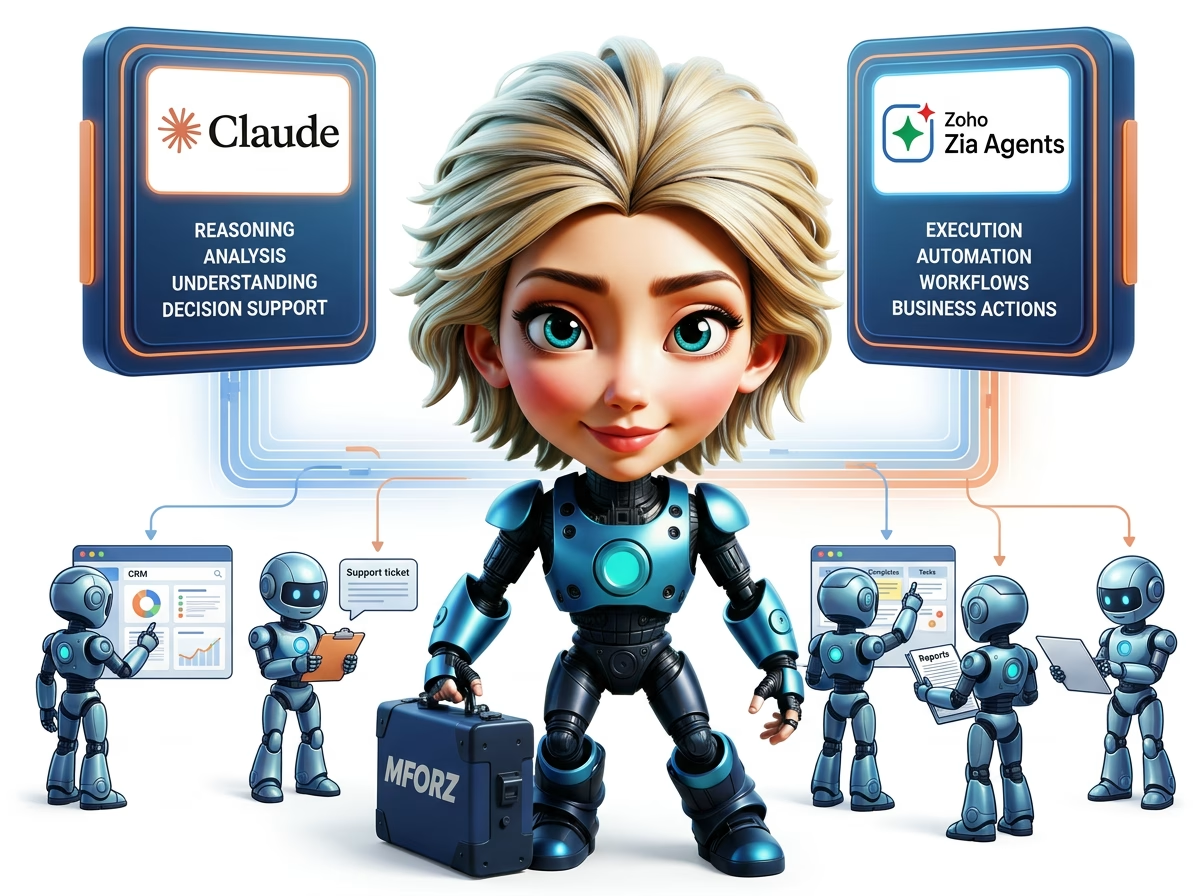
Which three layers work together?
Claude is the thinking layer. He reads what is there, weighs it against each other, and determines the approach. He does not change anything in your systems himself.
MCP is the connection layer. The protocol grants Claude access to your Zoho environment and translates his requests into actions that Zoho understands. It contains no logic itself and makes no decisions.
Zia is the execution layer. He trades within Zoho, quickly and at low cost, and does it the same way every time.
What does a complete process look like?
An existing customer sends an email: he wants to extend the contract but also has an ongoing complaint regarding last month's delivery.
Zia detects that an email has arrived on a known account and sets the process in motion. Up to this point, nothing smart has happened, just a trigger.
Claude reads the email via MCP and retrieves what he needs: the account, the open deals, the complaint history, the latest invoices. He sees that two things are happening simultaneously and that the expansion will likely stall as long as the complaint remains open. That is the verdict that guides the rest.
Claude replies: this is a commercial opportunity with an outstanding risk, the complaint must come first, and this is the proposed response.
Zia executes. The ticket is prioritized, the account manager receives a task with the context, the deal is created with a note regarding the dependency, and the draft response is ready.
A human approves the comment and sends it.
| Ask | Short answer | Floor |
|---|---|---|
| Which three layers work together? | Claude is the thinking layer. | Read more |
| What does a complete process look like? | An existing customer sends an email: he wants to extend the contract but also has an ongoing complaint regarding last month's delivery. | Read more |
| What goes wrong if you leave out a layer? | Without Claude, your trial lacks judgment. | Read more |
| What does this mean for the interior design? | The most important choice is where you draw the line between thinking and doing. | Read more |
| Where do you start? | You don't have to start with all three at the same time. | Read more |
What goes wrong if you leave out a layer?
Without Claude Your process misses the judgment. Zia can route the email but does not see that a commercial opportunity and a complaint are related. You end up with two separate processes running past each other.
Without MCP Claude does not have access to your data. Then he works on what you put on him, and that does not scale.
Without Zia Claude has to do everything himself. That is possible via MCP, but you are paying the model for work that could have been a rule, and you lose the predictability that you specifically want for routine tasks.
What does this mean for the interior design?
The most important choice is where to draw the line between thinking and doing. If you set it too high, you have the model perform actions that could have been a rule: expensive and unpredictable. If you set it too low, your process will still stall the moment a judgment needs to be made.
In the implementations I perform, I set that boundary at whether the answer depends on the content of a file. If it depends on that, it goes to Claude. If it depends only on field values, it stays with Zia.
Where do you start?
You don't have to start with all three at once. Most organizations start with MCP and Claude, because that is where you see fastest what a model does to your own data. Zia is added as soon as it becomes clear which actions are recurring.
Sources and product information
- Zoho, Agent Studio, official product information
- Zoho, Creating Agents, official product information