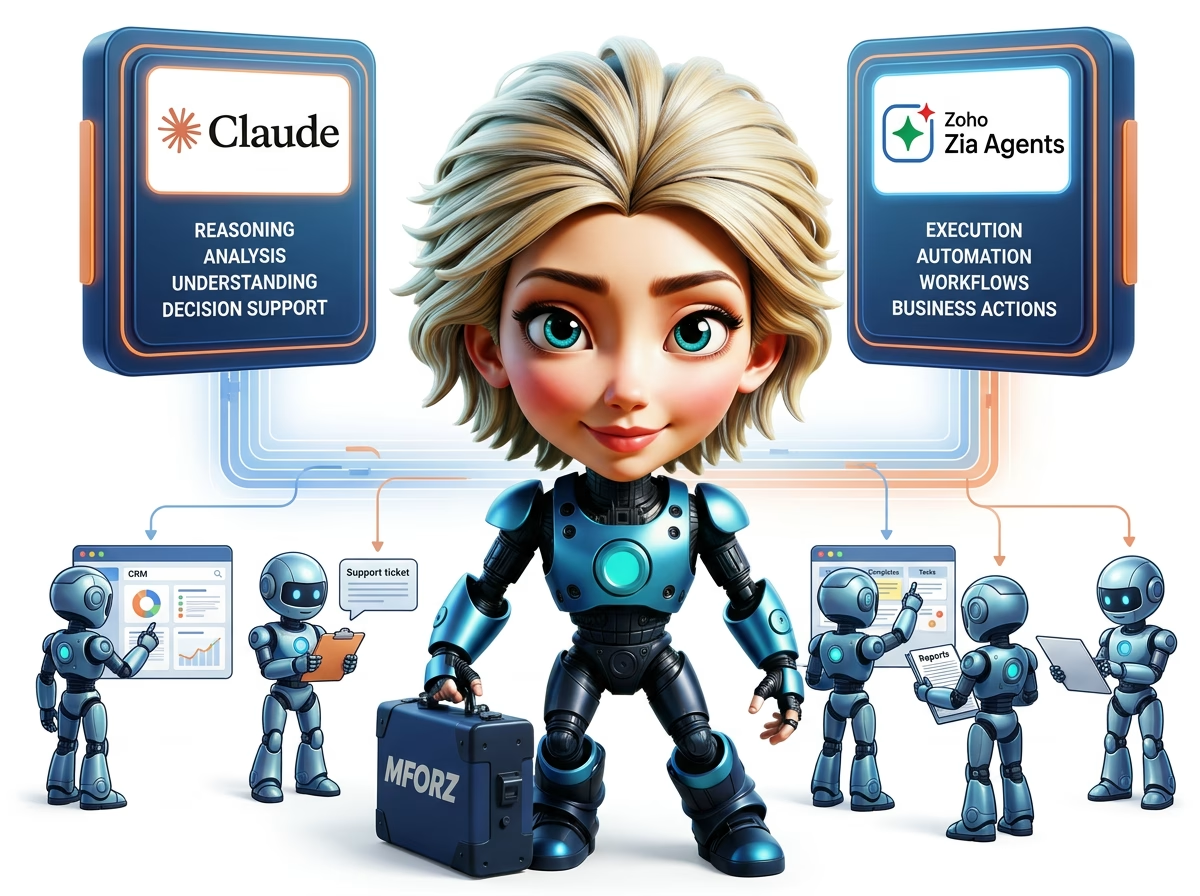
What is Zia good at?
Zia is based in Zoho and knows the structure of your environment: your modules, your fields, your pipelines, your permissions. Performing an action requires no detours for him.
This yields three advantages. It is fast, because no external call is required. It is inexpensive, because you do not pay separate AI costs per action. And it is predictable within its parameters, because the actions it can perform are fixed in the platform.
For work that occurs frequently and stays within Zoho, that is hard to beat.
What is Claude good at?
Claude is stronger in tasks involving judgment. Reading a long email exchange and extracting the core message. Assessing whether a client situation poses a risk. Writing a proposal text that aligns with what was said during the conversation. Maintaining an argument across multiple steps.
That comes down to two things: a large context window, allowing him to survey a lot of material at once, and better performance on tasks where there is no correct answer.
The downside: every call costs something, and the outcome is not identical every time.
| Ask | Short answer | Floor |
|---|---|---|
| What is Zia good at? | Zia is in Zoho and knows the structure of your environment: your modules, your fields, your pipelines, your permissions. | Read more |
| What is Claude good at? | Claude is stronger in tasks involving judgment. | Read more |
| When do you only need one? | Only Zia suffices if your work remains within Zoho and can be captured in rules. | Read more |
| Why do they work better together? | Most processes contain both. | Read more |
| How do you choose in practice? | The question I maintain is: can someone determine what needs to be done without thinking, based solely on the fields in the record? | Read more |
When do you only need one?
Zia alone suffices if your work remains within Zoho and can be captured in rules. Assigning leads based on region, categorizing tickets by subject, updating fields after a status change. An external model adds nothing to this except costs.
Claude alone suffices if the work is primarily intellectual and the outcome is a text or advice, not a change to your system. Preparing for a meeting, conducting an analysis, writing a document.
Why do they work better together?
Most processes contain both. They involve a moment of assessment and a series of actions that follow from it.
Take an incoming complaint. Assessing how serious it is, whether this customer has complained before, and whether there is a commercial risk involved is Claude's job. Setting the ticket to high priority, bringing in the account manager, creating a task, and sending the customer an acknowledgment of receipt is Zia's job.
If you split that, you only pay the model for the processing and let the rest run on what you already have. That is cheaper and more reliable than having a system handle both.
How do you choose in practice?
The question I keep asking is: can someone determine what needs to be done without thinking, based solely on the fields in the record? Then it is Zia. Does someone have to read, weigh, and interpret first? Then it is Claude.
If the description of your process states anywhere that it depends, then that is where the line is drawn.
Where do you start?
Take a process that is currently stuck because someone needs to review it. There is usually a small judgment component in an otherwise automatable chain. That component is what you delegate to Claude.
Sources and product information
- Zoho, Agent Studio, official product information
- Zoho, Creating Agents, official product information