How does a traditional API integration work?
Suppose you want new leads from your website to automatically appear in Zoho CRM, along with a summary. Traditionally, this works like this: someone writes code that reads the form, creates a record in CRM, sends the text to an AI model, receives the response, and places it in a field.
That code works exactly as well as it is written. If you want to add a step, the code must be modified. If Zoho changes a field name, the connection breaks. If you want the same for quotation requests, you rebuild it.
That is not a criticism of API connections. For a process that has to happen the same way a hundred times every day, that is exactly what you want: predictable and fast.
What does MCP do differently?
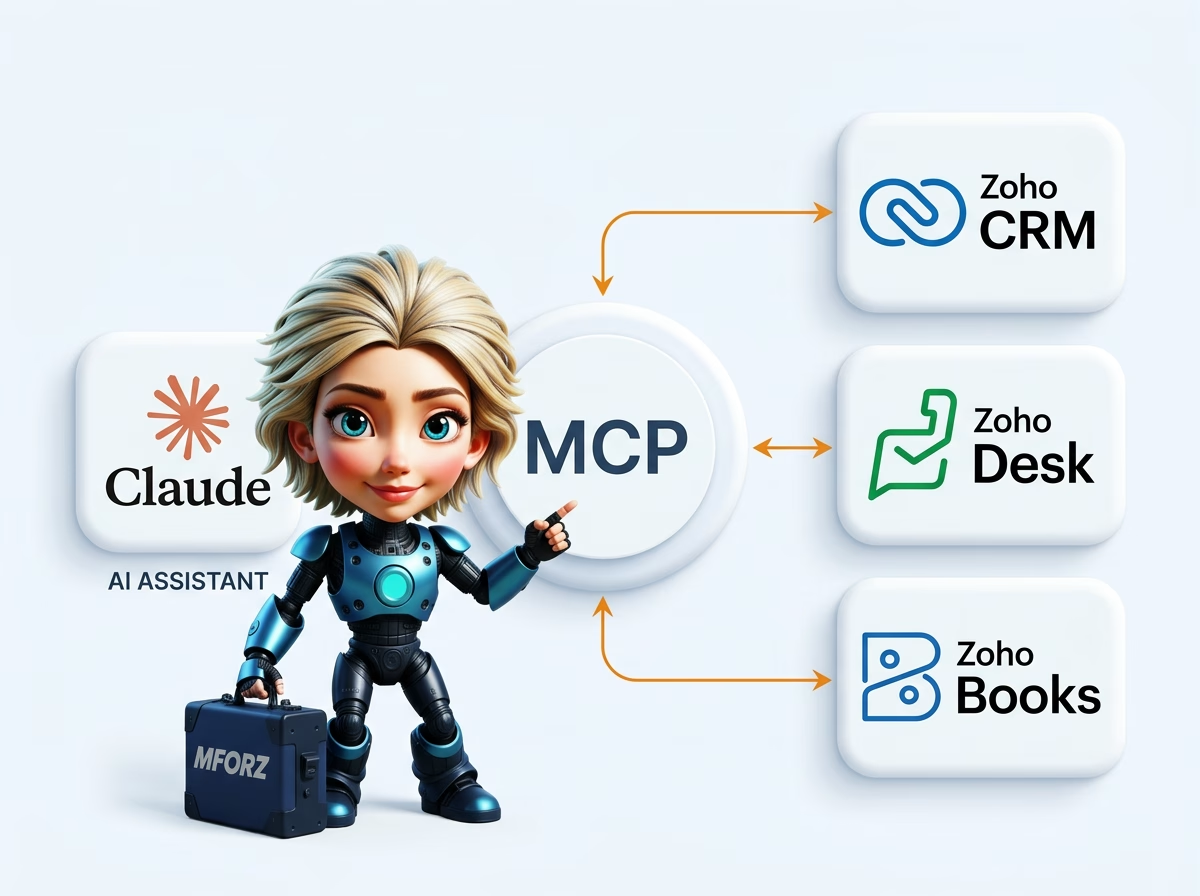
With MCP, you don't write down steps. You give the model access and tell it what you want to achieve.
The MCP server reports to the model which actions are available: search records, create, update, read email, retrieve documents. The model receives that list and decides for itself what it needs for each query.
If you ask for a customer summary, the model retrieves the account, the associated deals, the latest emails, and open tickets. If you ask for only the phone number, it retrieves only the contact. No one programmed those two scenarios separately.
| Ask | Short answer | Floor |
|---|---|---|
| How does a traditional API integration work? | Suppose you want new leads from your website to automatically appear in Zoho CRM, along with a summary. | Read more |
| What does MCP do differently? | With MCP, you don't write down steps. | Read more |
| What does this mean for maintenance? | This is where, as far as I am concerned, the biggest practical difference lies. | Read more |
| When do you choose which one? | An API integration or a fixed workflow is suitable for processes that always run the same way, where the outcome must be exactly predictable, where the volume is high, and where no judgment is required. | Read more |
| Can you combine them? | Yes, and that is usually the best setup. | Read more |
What does this mean for maintenance?
This is where, as far as I am concerned, the biggest practical difference lies.
An API connection is something you own and maintain. Every change in your process is a change in the code. For clients with ten or fifteen such connections, maintenance has become a fixed monthly expense, and often no one knows exactly what is running anymore.
An MCP connection does not have that property. If your process changes, you change your instruction. That is text, not code, and someone without a technical background can modify it.
There is a trade-off: an MCP connection is less predictable. The model makes the choice itself, and that choice can vary each time. You do not want that for a financial entry.
When do you choose which one?
An API integration or a fixed workflow is suitable for processes that always run the same way, where the outcome must be exactly predictable, where volume is high, and where no judgment is required. Synchronizing invoices, updating inventory levels, sending a confirmation email.
MCP is suitable for work involving context and assessment. Assessing a lead, preparing a quote, summarizing a ticket, analyzing a client situation. Work where the answer depends on what is in the file.
Most organizations need both. In the implementations I do, existing automation simply remains in place, and MCP is added on top for the work that doesn't fit.
Can you combine them?
Yes, and that is usually the best setup. Claude determines via MCP what needs to be done and prepares the action. An existing workflow or a Zia Agent executes the deterministic part.
Example: A new request comes in. Claude reads it, determines the type of request and the associated pipeline. That judgment comes from the model. The subsequent steps, creating the deal and assigning it to an account manager, take place via a standard workflow. That doesn't need to be smart.
What does this mean for your situation?
If you currently have integrations that require frequent adjustments, that is a signal. An integration that requires maintenance every quarter because the process changes is usually an integration that actually contains a judgment. That kind of work is better suited to MCP.
Sources and product information
- Zoho MCP, official product information
- Anthropic, Model Context Protocol, official product information